A 100- or 200-pair footwear trial should not try to test every possible custom feature. It should test the few product decisions that will determine whether customers respond. At Yangzhou JNP, we usually balance low MOQ custom footwear by keeping a proven construction, protecting the brand details that matter most, and postponing investments that only become economical at scale.
What Should a Footwear Trial Order Actually Prove?
A trial order should prove the product idea, customer response and price position—not reproduce every condition of a large production programme.
An original last, exact Pantone dyeing, exclusive hardware, custom packaging and project-specific testing may each be reasonable. Together, they create several fixed commitments before the market has answered its first question: will the product sell?
We find it more useful to decide what the brand needs to learn. Is the distinctive value in the silhouette, the material feel, a piece of embroidery or the way the shoe fits? The first order should preserve that element clearly enough for the customer to react to it.
Which Custom Details Deserve the First-Order Budget?
Protect custom details with high customer value, and be cautious with details that add production complexity without changing the buying decision.
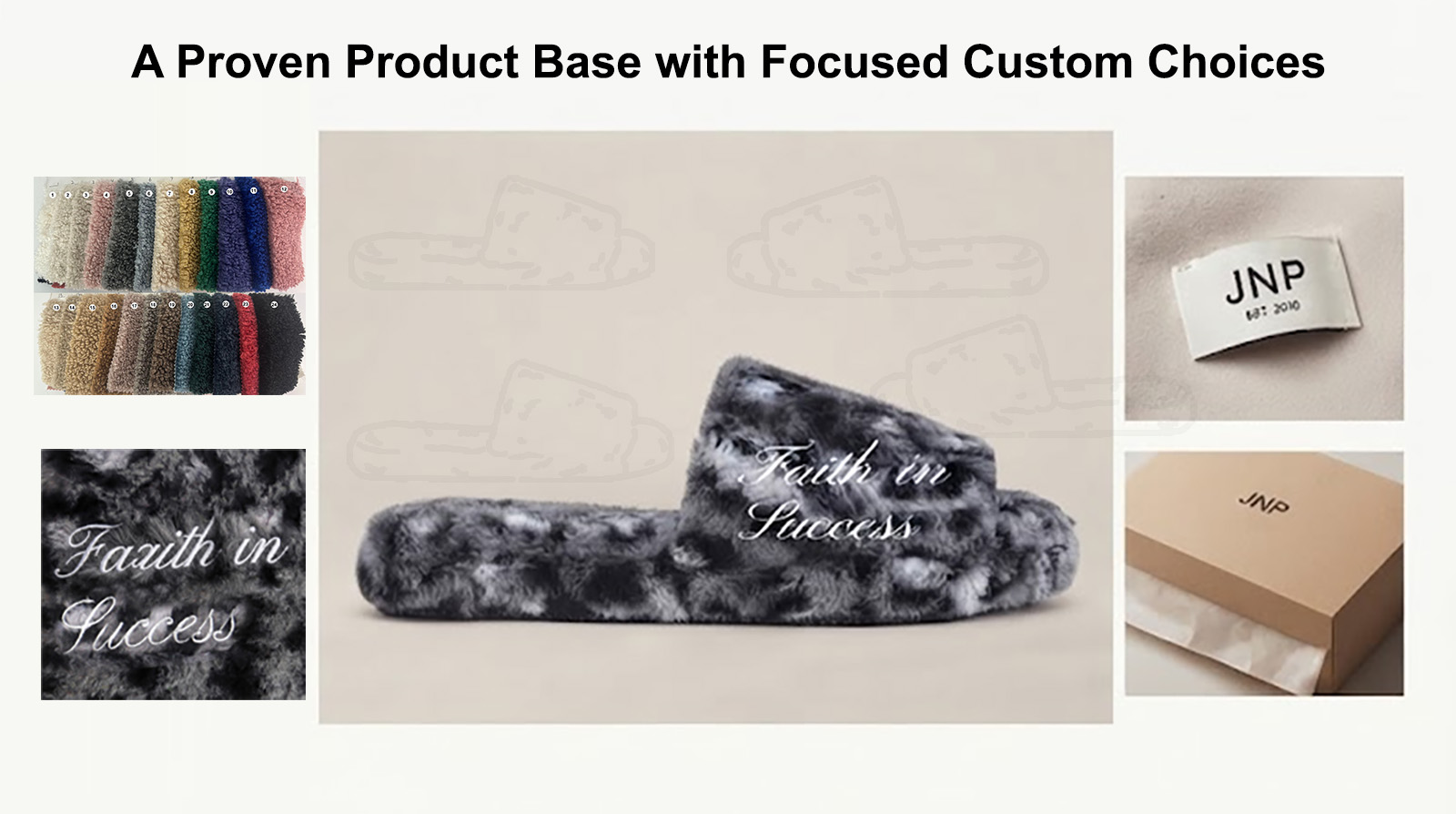
At JNP, a style becomes a low-MOQ customisation base only after we assess market direction, recurring buyer needs and trend momentum. The styles we retain are usually reordered by customers and refined through successive feedback.
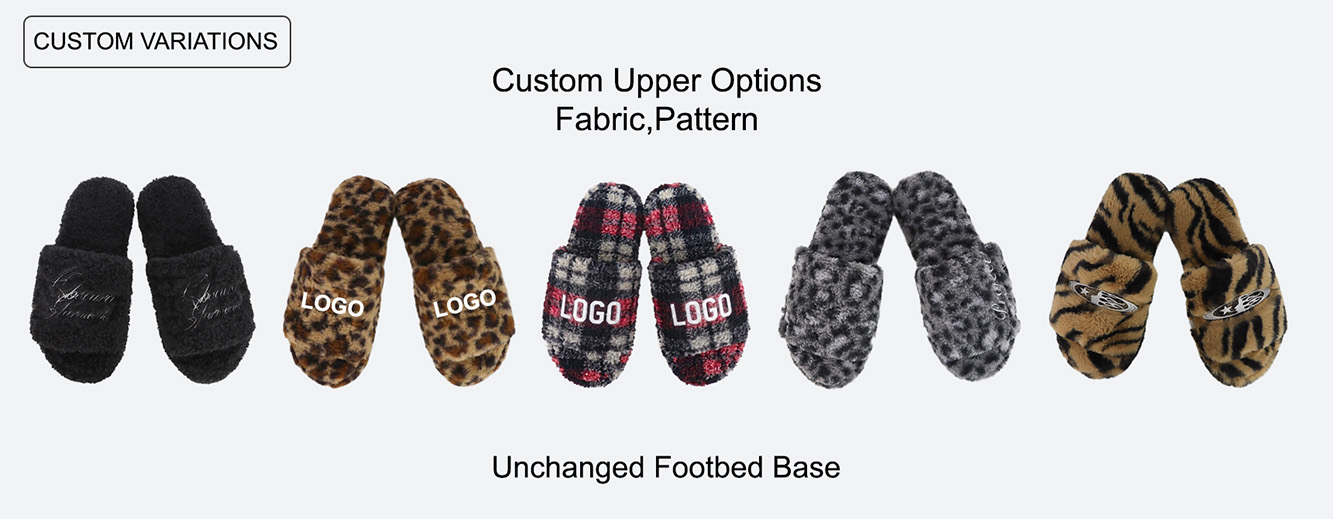
This gives buyers a proven starting point while leaving colour, material, embroidery, trims and packaging open for brand expression. It is not a stock shoe with a logo, but an already-tested product base ready for focused differentiation.
| Decision type | Recommended trial-order approach |
|---|---|
| High customer value, lower complexity | Keep it in the first order; suitable branding details may include embroidery, labels or insole printing |
| High customer value, higher complexity | Protect it if it defines the product; reduce complexity elsewhere |
| Lower customer value, lower complexity | Add only if it supports the overall product and budget |
| Lower customer value, higher complexity | Postpone until sales evidence justifies the investment |
For one brand, a new silhouette may be essential. For another, the signature may come from material, colour and embroidery. The decision begins with what the target customer will notice and value.
McKinsey’s analysis of customisation complexity reaches a similar commercial conclusion: each variation should be judged by both customer value and its less-visible costs across the value chain.
Why Is Footwear MOQ More Than One Number?
A custom footwear MOQ is the combined result of several modules, each with its own economic starting point.
The shoe assembly may support a small run while one dedicated fabric, moulded trim or printed box pushes the real commitment much higher. This is why one headline MOQ rarely explains whether a design is feasible.
| Module | Lower-commitment trial route | What may raise the MOQ |
|---|---|---|
| Last, pattern and sole | Use a proven construction | New tooling or a completely independent structure |
| Colour and material | Match a Pantone reference to the closest suitable available material | Dedicated dyeing or material production |
| Branding | Use feasible embroidery, labels or insole printing | Complex placement, construction changes or special processes |
| Trims | Select suitable parts from the current supply chain | Exclusive hardware, tooling or finishes |
| Packaging | Choose a format that fits the trial quantity | Dedicated structures and packaging-supplier minimums |
| Compliance | Define the required documents after materials are confirmed | Project-specific testing across multiple components |
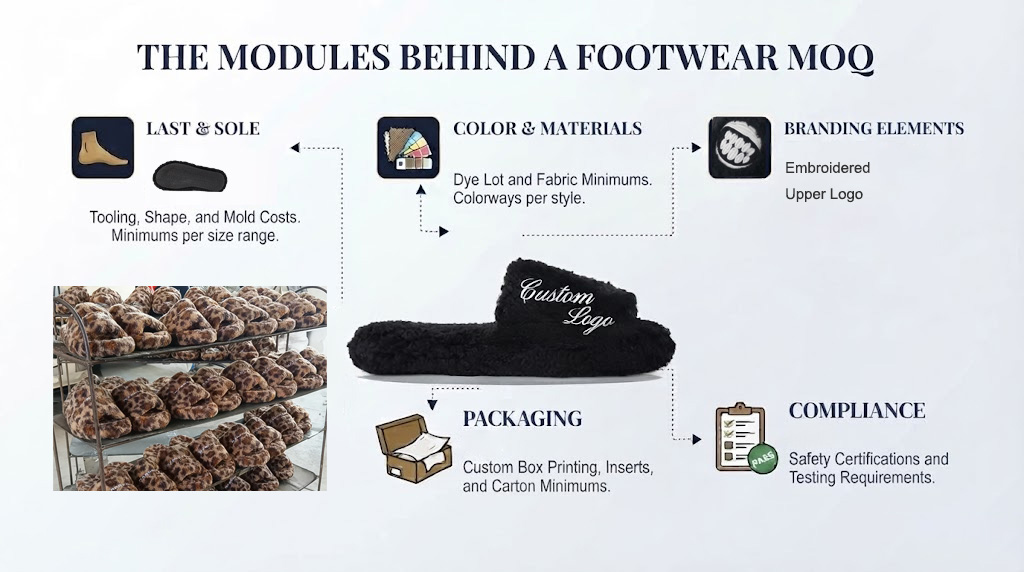
In our experience, some custom fabrics may require around 10,000 metres for a dedicated run. Depending on the material and consumption, that may support at least roughly 3,000 pairs of footwear. For a small trial, matching the closest available colour often protects the visual direction without creating unused material exposure.
The same logic applies to testing. A lower-cost third-party REACH test for a simple style may start at around US$600.00 or even more, but the actual cost depends on the design and scope. Final materials and components should be confirmed before testing is quoted. The European Chemicals Agency’s guidance on substances in articles is a useful starting point, but the buyer should still clarify the document required by its market or retail channel.
These are experience-based examples, not fixed terms for every project.
Which Development Route Fits Your Current Stage?
The right route depends on what the business already knows, what it still needs to learn and how much irreversible investment it can support.
| Route | Best suited to | Development approach | Main question answered |
|---|---|---|---|
| Lean market test | A new concept with limited sales evidence | Proven construction, closest available materials and a few visible brand details | Will customers buy this product idea? |
| Brand-led trial | A brand with a clear identity but limited footwear history | Proven base plus two or three high-priority signature elements | Does the brand expression improve customer response? |
| Independent development | A validated concept whose value depends on original construction or materials | New structure, dedicated components and a project-specific testing plan | Can the product become a scalable, defensible platform? |
The question then changes from “Can you do full customisation at 200 pairs?” to “What needs to be custom now, and what evidence would justify the next level?”
Where Should a Buyer Start?
Start with the product style and a clear picture of the customer—not a long checklist of factory decisions.
Product style
What product are you trying to offer? One or two reference images are enough to open the conversation.
Size range
Who will wear the product, and in which market? Let that customer profile guide the size range.
First-order quantity
How many suitable customers can the brand realistically reach through its planned channel? Let that estimate—not factory MOQ alone—guide the starting quantity.
Price position
What can that audience reasonably pay? Use its purchasing power to set the price position and guide the product choices that follow.
JNP can then translate these commercial inputs into product and production choices.
A useful proposal separates what fits the trial, what needs a larger commitment and what should wait for customer feedback. Packaging has its own MOQ logic; our guide to slipper packaging for small orders explains the trade-off.
The best trial order is not the one with the most custom features. It is the one that preserves the product idea, gives the brand credible market evidence and leaves a clear path to scale.
Yangzhou JNP works as a footwear sourcing and production partner rather than a single factory. We help buyers match the right production base to the right stage of the business, decide where customisation creates real value and plan what can wait for the next order. To discuss a trial project, send Amanda your reference images, quantity and non-negotiable product details at am****@*********ar.com.